
The Bus Crash on Lincoln Road Was Five Years Ago. The Newsletter Still Remembers.
September 10, 2026
September 10, 2026
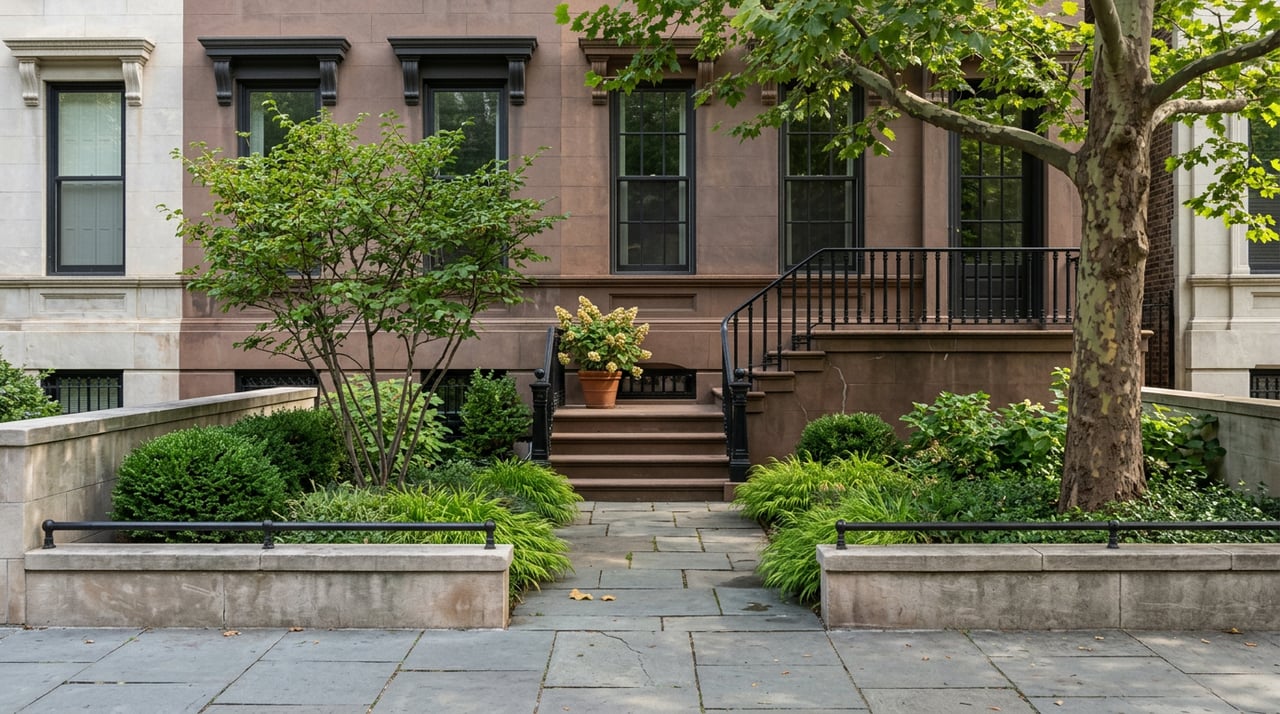
Walk the block of Lincoln Road between Flatbush and Ocean and you will pass a limestone rowhouse that still carries visible damage from a 2021 collision with a B49 bus. Five years is a long time for a fix to sit unfinished on a residential block, especially one inside a landmarked historic district where every cornice and window line is supposed to answer to the city. But the most detailed accounting of what happened to that building, and why it is still not repaired, did not come from a Department of Buildings docket or a City Council press release. It came from the Lefferts Manor Echo, a newsletter that a volunteer association mails to homeowners twice a year.
That is the thing about Prospect Lefferts Gardens worth knowing if you already live here: the institution that actually tracks what happens on these blocks is not a government office. It is a newsletter, a ticket table outside a restaurant, and a short list of shops on Flatbush and Lincoln that have been doing this job, unpaid, for over a century.
Lefferts Manor is the eight-block core of the neighborhood, bounded by Lincoln Road, Flatbush Avenue, Fenimore Street, and Rogers Avenue. In 1893, James Lefferts attached deed restrictions to the lots he was selling, requiring brick or stone construction, a minimum of two stories, and strictly single-family use. Those restrictions still bind roughly 600 homes today. The Lefferts Manor Association formed in 1919 specifically to enforce them, years before the city's Landmarks Preservation Commission designated the surrounding Prospect Lefferts Gardens Historic District in 1979.
That timeline matters. The Association was writing rules and settling disputes about this neighborhood for six decades before landmarking gave the city any formal role here. The covenant is the older authority. The Echo is how that authority still gets communicated, twice a year, in a document that reads more like a small-town paper than a homeowners' bulletin.
The Spring 2026 edition of the Echo ran a piece by David Flumenbaum titled "Five Years Later, Lincoln Road Crash Site Frozen in Time," an update on why the damaged rowhouse at 174 Lincoln Road remains unrepaired half a decade after the crash. The article pulled in comments from neighbors, the Department of Buildings, the MTA, City Council Member Rita Joseph, and the adjacent property owner. Reading it, you get the sense that this is not a story anyone else was assembling in one place. The city agencies each hold a piece of the file. The Echo is the only party that has been checking back in on all of them, year after year, and telling the block what it found.
That is a different kind of local reporting than most neighborhoods get. Fort Greene has its landmarks casework, Boerum Hill has its Atlantic Avenue turnover, but few Brooklyn newsletters are still doing five-year callbacks on a single infrastructure failure with named officials on record. If you live near Lincoln Road and have wondered why that facade still looks the way it does, the answer already exists. It is just filed in a PDF from a volunteer association rather than anywhere the city publishes on its own.
The clearest evidence that commerce and civic life are the same network here is the annual PLG House & Garden Tour. The 2026 edition was the 52nd, held Sunday, May 31, with eight homes opened to the public and a companion gathering called the Lefferts Lounge featuring live music coordinated by PLG Arts. There is no ticketing app or central box office. Advance tickets were sold at four specific addresses: DRINK at 492 Flatbush Avenue, Trixie's Pet Food Supplies & Accessories at 575 Flatbush Avenue, Little Mo Wine & Spirits at 1125 Nostrand Avenue, and Ix at 43 Lincoln Road, which also served as the day-of check-in table.
Those four storefronts are not incidental. They are the informal distribution network for one of the neighborhood's oldest civic traditions, the kind of arrangement that only works because the businesses and the association trust each other enough to hand cash and wristbands back and forth across a counter. A wine shop, a pet store, a bar, and a restaurant are effectively running the box office for a tour that predates most of Brooklyn's remaining house tours, several of which have folded in the last decade while this one keeps going.
The Association's rhythm does not stop with the tour. Membership costs $30 per household, or $20 for seniors, and includes one holiday wreath, with wreath distribution for 2026 scheduled for Saturday, December 5. The tradition of planting the neighborhood's street-corner flower barrels each spring is old enough that the Echo has run a full history of it as its own feature. None of this shows up on a city parks calendar. It exists because a handful of residents keep deciding to do it again the following year.
If you are new enough to the neighborhood that this all sounds like trivia, it is worth understanding the pattern behind it. In a lot of Brooklyn neighborhoods, the visible civic infrastructure is a community board meeting or a city council office. In Lefferts Manor specifically, the Association has been the primary civic infrastructure since before the Board even existed in its current form, and the Echo is still the paper trail of record for anything from a wreath count to a bus crash claim.
Step outside the Manor's eight blocks and the same pattern holds, just with different names attached. The Grand Army Plaza Greenmarket has connected local farms to Park Slope, Prospect Heights, Crown Heights, and Prospect Lefferts Gardens shoppers every Saturday since 1989, long enough that it predates most of the housing stock currently listed as "new development" along Flatbush. Scoops has served vegan ice cream and vegetarian food on Flatbush Avenue since 1984. Bar Bayeux on Nostrand Avenue has built a reputation for live jazz that draws people from well outside the neighborhood. None of these are recent additions dressed up as discoveries. They are fixtures that have outlasted multiple waves of turnover on the same two commercial corridors, Flatbush and Nostrand, that carry most of the neighborhood's daily errands.
What ties the flower barrels to the Greenmarket to the ticket table at Ix is the same instinct: nobody is waiting for a city department to organize it. The organizing already happened, decades ago in some cases, and it keeps happening because the same small set of people and storefronts keep showing up for it.
If you are a homeowner in Lefferts Manor and have never joined the Association, the $30 membership is less a fee than a subscription to the only publication that will tell you what is actually happening to the building down the block, five years out if that is how long it takes. If you live in the broader neighborhood outside the covenant streets, the House Tour and its four ticket outlets are worth knowing even if you never buy a ticket, because they are a fast way to understand which storefronts the neighborhood trusts enough to run its civic calendar through.
And if you pass 174 Lincoln Road again this fall, know that the facade is not an oversight. It is an open file, one that a volunteer newsletter has been the only party willing to keep checking on, long after the initial news cycle moved on. That is not a small thing for a neighborhood to have. Most places lose that kind of institutional memory the moment the people who built it move away or stop paying attention. Prospect Lefferts Gardens has not, at least not yet.
If you are thinking about what a home in Lefferts Manor or the surrounding blocks might mean for you, from the covenant's rules to what the market actually looks like right now, Hilah Hadaway Williams has spent years working this exact stretch of Brooklyn and is glad to talk through it. Let's Connect.
Stay up to date on the latest real estate trends.


With a proven track record and a personalized approach, Hilah delivers a seamless, strategic experience designed around your goals.